
The World Defence Show held in Saudi Arabia (4-8 February 2024) was exceptionally productive for Türkiye’s defence industry, as Turkish firms showcased their lead on the global arena. Notably, significant agreements by leading entities like Baykar, Turkish Aerospace Industries (TAI) and the defence powerhouse Aselsan stood out.
In this multifaceted analysis, TRT World Research Centre experts unpack the factors contributing to the rise of the Turkish defence industry.
Click to jump to an expert reaction:
Dr Tarek Cherkaoui: Türkiye’s Defence Industry Continuous Ascension
Burak Elmalı: Türkiye’s Defence Industry Underpins a Confident Foreign Policy
Ferhat Polat: Türkiye-Arab Defence Cooperation: Boosting Regional Security and Economic Growth
Hüseyin Özdemir: Türkiye’s Defence Industry has been boosted by Geo-political Upheavals
Şeyma Yönt: Türkiye’s Defence Industry: An Economic Perspective
Çağdaş Yüksel: Türkiye’s Sovereignty is inherently linked to its Maritime Security
Ömer Carullah Sevim: Türkiye’s Strategic Defence: Navigating Autonomy and Influence
Ihsan Faruk Kılavuz: Turkey’s Aerospace Industry: A Leap into Global Defence Leadership
Dr Tarek Cherkaoui: Türkiye’s Defence Industry Continuous Ascension
Over recent years, Türkiye has significantly developed its defence industry, boosting the operational capabilities of its armed forces and increasing its geopolitical influence through expanded exports. Since the AK Party government ascended to power in 2002, the government pushed towards defence modernization, with a notable pivot towards domestic production in 2004 to boost the national industrial contribution to conventional warfare capabilities. Strategic plans laid out between 2012 and 2023 have furthered the ambition for technological sovereignty and sustainable defence industry growth, emphasising technological transformation and workforce development.
The impact of Türkiye’s defence advancements is globally recognized, notably in drone warfare, with Turkish drones like the Bayraktar TB-2 playing pivotal roles in international conflicts. Beyond armed drones, Türkiye’s defence industry has made significant strides, now possessing the capability to design, produce, modernise, and export a wide array of core conventional arms and equipment. This includes corvettes, fire support systems, unmanned aircraft systems, gliding munitions for drones, joint-direct attack munitions, various land warfare platforms (save for main battle tanks), grenade launchers, and tactical anti-material rifles, with varying degrees of domestic input.
While Türkiye’s indigenous defence sector has covered a wide array of much needed defence capabilities, it still requires international collaboration for developing strategic and high-end weaponry, such as exo-atmospheric ballistic missile defence systems, fifth-generation military aviation, and space-based assets. On several occasions, Turkish decision-makers found creative solutions as when they signed an agreement for defence cooperation with Ukraine, enhancing cooperation in strategic industries, and allowing Türkiye’s defence industry to tap into a reservoir of Ukrainian know-how in defence matters.
Türkiye’s defence exports have diversified, reaching over 170 countries, with the industry’s project portfolio expanding to include 750 projects by over 1,500 local firms. Despite international challenges, Türkiye’s defence spending and industry turnover have seen steady growth, underscoring its emergence as a player to be reckoned with in the global defence market.
Baykar is a case in point. The Istanbul-based corporation has become one of the leading Turkish arms manufacturers. Signalling its international expansion drive, this defence company announced in Saudi Arabia’s 2024 World Defence Show the construction of a drone factory in Kyiv to produce Bayraktar TB2 UCAVs and plans to open a similar facility in Saudi Arabia in what Baykar described as the biggest defence contract in Türkiye’s history. The addition of 60 Akıncı UCAVs to Baykar’s sales portfolio is another boost for Türkiye’s arms exports in the region that is added to other impressive business deals, such as the 2022 UAE’s $2 billion offer for 120 Turkish Bayraktar TB2 drones, including training and support, which marked a major defence collaboration between the two sides. All these impressive deals, and many more in the pipeline, reflect Türkiye’s expanding footprint in the Middle East’s defence landscape.
The Arab market is not the only one seeking Turkish defence products. Turkic and African states are increasingly interested to procure arms from Türkiye. This has also contributed to the warming of relations between Ankara and these countries, paving the way for stronger diplomatic ties.
Nevertheless, the path forward for Türkiye’s defence industry, particularly in areas requiring advanced technological capabilities, will likely necessitate continued international partnerships and innovation. Yet, the economic resilience of Türkiye’s defence sector, even amid the pandemic and global economic slowdown, showcases a robust and growing industry, with significant increases in revenue, exports, and research and development activities.
Burak Elmalı: Türkiye’s Defence Industry Underpins a Confident Foreign Policy
The strides taken by Türkiye toward achieving self-sufficiency with a special focus on ‘domestic and national’ character in its defence industry have undeniably wielded significant influence over the contours of its foreign policy. These advancements have not only enabled the prioritised diplomatic objectives to manifest with tangible backing, beyond mere rhetoric but have also facilitated the implementation of a more proactive foreign policy stance. Notably, the indigenous production of unmanned aerial vehicles, missiles, air defence systems, warships, tanks, and other defence inventory vehicles, grounded in local and national imperatives, alongside the global recognition garnered by the Bayraktar TB2 drones, have served as concrete manifestations of Türkiye’s aspirations for a self-reliant defence industry.
The indigenous and nationalistic transformation pursued within the defence industry also bears a dimension that can be unequivocally linked to foreign policy, namely, the constraints and pressures historically imposed by imported defence industry products. In this regard, Türkiye, which has in a sense embraced Import Substitution Industrialization tactics, has preemptively mitigated potential issues that could have adversely impacted its foreign policy stance (such as the contentious process of procuring F-16s from the United States). The defence industry, while inward-looking, has concurrently developed a sensitivity to external developments and demands, thus serving as a crucial complementary element in achieving foreign policy priorities.
The attainment of a position liberated from external dependencies in the pursuit of foreign policy goals has, in turn, propelled proactive diplomatic endeavours forward. For instance, Türkiye’s support for the UN-recognised government in Libya (formerly known as the Government of National Accord, GNA), aimed at safeguarding national interests in the Eastern Mediterranean concerning the extraction and processing of hydrocarbon resources and the preservation of the Exclusive Economic Zone (EEZ), has significantly shifted the dynamics of the conflict, affording the GNU tactical leverage and optimising economic gains.
The sequence of events, exemplified by the agreement with the Tripoli-based government in 2019, Türkiye’s intervention in 2020, and the subsequent signing of a hydrocarbon reserves agreement in 2022, serves as a case in point. Backed by a robust defence industry, Türkiye has instilled confidence in the efficacy of bilateral agreements in its proactive foreign policy manoeuvres. Furthermore, the burgeoning strength of the domestic defence industry, underscored by tangible performance rather than mere rhetoric, has been supported by another agreement in 2022.
Similarly, Türkiye’s steadfast support for Azerbaijan, a perennial priority in its foreign policy agenda, during the 2020 Nagorno-Karabakh War, particularly through the deployment of Turkish defence industry products, notably the Bayraktar TB2, significantly contributed to Azerbaijan’s resounding victory over occupying forces from Armenia.
Moreover, the evolution of Türkiye’s balancing foreign policy, marked by the sale of Bayraktar TB2 drones to Ukraine amidst the Russia-Ukraine War while simultaneously maintaining open channels of communication with Moscow, epitomises another nuanced strategic approach.
Without these advancements in the defence industry, Türkiye might have been limited to a diplomatic approach marked by eloquent rhetoric but devoid of substantial action. In conclusion, the assertive stance of Turkish foreign policy, coupled with progress in its defence sector, establishes Türkiye as a prominent player that effectively protects its national interests and maintains strategic balance in the global arena.
Ferhat Polat: Türkiye-Arab Defence Cooperation: Boosting Regional Security and Economic Growth
Türkiye has undergone a defence transformation since the early 2000s, prioritising self-reliance and a techno-nationalist approach. National security resources have been allocated with a keen understanding of contemporary global challenges, including energy, defence, security, and the ongoing battle against terrorism (Yilmaz and Yorulmaz 2023).
This quest has led to a strong focus on developing domestic production and technologies to meet the growing demands of the Turkish army. Given the surge in the number of companies and personnel in the sector, the defence industry has emerged internationally as an example of Türkiye’s independent stance. One example of Türkiye’s progress in the defence industry is the development of domestically-produced unmanned aerial vehicles (UAVs) known as drones. These UAVs have been successfully deployed in various military operations such as in Libya, showcasing Türkiye’s advanced technological capabilities.
Ankara aims to decrease its dependence on foreign suppliers and transform the nation into a prominent arms exporter. Some of these plans have already made significant progress. The turnover experienced a significant increase, going from $1bn in 2002 to $11bn in 2020. The second-largest army in NATO depended on foreign suppliers for 70% of its needs. It has now decreased to 30% (The Economist 2022). During the war in Libya, Turkish flagship Bayraktar TB2 drone has proven effective on the battlefield. It generally costs less and performs better than rival models.
Turkish defence products are gaining popularity in Arab countries due to the openness of Turkish companies in sharing know-how. This includes areas such as drones and operating systems. Turkish manufacturers succeed in providing training, going above and beyond their competitors. They ensure that their company personnel are stationed in importing countries for a year or even longer, guaranteeing comprehensive support. This level of commitment and dedication has earned the trust and loyalty of Arab countries, who value the knowledge sharing and long-term support provided by Turkish companies. It also enables Türkiye and Arab countries to collaborate in the defence sector through technology transfer, skill-sharing, and intelligence-sharing, which is crucial to providing security in the region and organising joint research initiatives on military technology. This collaboration in the defence sector not only strengthens the relationship between Türkiye and Arab countries but also fosters a sense of unity and collective security in the region.
Engaging in defence collaborations with Arab countries offers Türkiye several strategic benefits. It boosts Türkiye’s regional clout, cementing its role as a pivotal actor in the Middle East and North Africa (MENA) landscape. For instance, providing military assistance and know-how in situations like the Qatar Crisis, the Libyan conflict, and the Syrian war enhances Türkiye’s standing as a crucial contributor to regional stability, fostering avenues for more partnerships across different domains. Moreover, the income generated from Turkish defence exports can fuel further innovation and advancement in Türkiye’s defence sector, bolstering its technological prowess and capabilities
For decades, Arab countries were at the mercy of the hegemonic influence of global powers regarding defence procurement (Telci̇ 2023). However, this has begun to change in recent years with the emergence of new actors in the field of the defence industry. These new actors, such as Türkiye, have successfully developed their own defence industries, reducing their dependence on global powers. Hence, collaboration in critical sectors like military and defence bolsters mutual trust between Türkiye and Arab nations, enhancing their collective readiness against external threats.
This shift has allowed Arab countries to diversify their defence partnerships and strengthen ties with regional allies. As a result, Arab countries are no longer solely reliant on global powers for their defence needs, leading to a more balanced and multipolar international system in the field of defence. This development has benefited both Türkiye and Arab countries, as they work together to build a more secure and self-reliant region.
References:
Telci̇, İsmail Numan. 2023. ‘From Cooperation to Consolidation: The Future of Turkish-Gulf Relations,’ Al Jazeera Centre for Studies. 4 October 2023. http://studies.aljazeera.net/en/analyses/cooperation-consolidation-future-turkish-gulf-relations.
The Economist. 2022. ‘Turkey Is the Arms Industry’s New Upstart’. The Economist, 12 February 2022. https://www.economist.com/europe/2022/02/12/turkey-is-the-arms-industrys-new-upstart.
Yilmaz, Serdar, and Murat Yorulmaz. 2023. ‘The Effects of Turkish Defense Industry’s Transformation on Turkish Foreign Policy’. İnsan ve Toplum Bilimleri Araştırmaları Dergisi 12 (1): 1–21. https://doi.org/10.15869/itobiad.1186736.
Hüseyin Özdemir: Türkiye’s Defence Industry has been boosted by Geo-political Upheavals
Although the Turkish defence industry traces its roots back to the inception of the Republic, its progression has been notable in the past two decades, propelled by substantial support and incentives. Prior to that, reliance on imports for various components of defence industry products constrained Türkiye’s autonomy. This reliance, at times, left Türkiye exposed. For instance, when Israel withheld access to Heron drones, the Turkish leadership recognised the imperative of self-reliance.
The dynamics in regions like Libya, Syria, Karabakh, and most recently Ukraine underscored the risks of dependency, as certain countries withheld critical parts and defence systems, attempting to coerce Türkiye through sanctions and embargoes. Nevertheless, unlike many nations subjected to sanctions, Türkiye leveraged these challenges as opportunities, cultivating a domestic industry to produce embargoed components.
In essence, embargoes catalysed Türkiye’s domestic production of high-tech goods, liberating it from reliance on foreign entities and bolstering its national wealth. By mitigating foreign dependencies in the defence sector, the nation not only circumvents exorbitant upfront costs but also gains the flexibility to modify products as needed, at a significantly lower expense.
Today, Türkiye boasts defence industry giants like Aselsan and Havelsan, along with renowned brands such as Baykar. However, it has strategically opted to engage subcontractors to produce sanctioned components. This decision has not only fostered the growth of numerous small enterprises but also diversified the range of production. The objective of these major corporations is not to solely generate profits but also to broaden the Turkish defence industry footprint worldwide.
Previously imported electronic components are now being domestically manufactured by small-scale companies, with defence industry giants integrating these parts into their operations. This decentralised approach has kept production lines dynamic, directing smaller entities towards specific needs and thereby enhancing overall production capacity. Over time, these small enterprises have seized growth opportunities, catalysing the advancement of national production.
Türkiye’s strategic agreements with Ukraine, signed long before the 2022 Ukraine-Russia conflict have been crucial for the Turkish defence industry’s advancements. These agreements encompass the exchange of skilled engineers from both nations, naturally facilitating technology transfer. Ukraine’s defence industrial base, though weathered by the war, retains substantial potential especially in engine production technology.
Establishing Ukrainian Motor Sich’s office in Ankara and close ties with Ukrainian engine developer Ivchenko Progress underscores the capabilities of Türkiye’s defence industry. Despite the ongoing conflict, Baykar’s recent announcement of completing the UAV production facility in Ukraine, a plan in the works for years, reaffirms Türkiye’s commitment to advancing its defence industry. These strategic decisions will undoubtedly bolster Türkiye’s prominent position in the global defence landscape in the years ahead.
Collaborations with Motor Sich and Ivchenko Progress will not only accelerate UAV production but also address the soaring demand for TB2 and TB3 model UAVs. More importantly, it will pave the way for developing cutting-edge technology products like Türkiye’s fifth-generation fighter jet, KAAN.
While external factors such as the conflicts in Syria, Karabakh, and Ukraine have spurred a new phase in Türkiye’s national defence production, a recent domestic tragedy holds promise for the industry. In response to devastating earthquakes affecting 11 provinces, the major defence industry players have strategically resolved to establish campuses in each of these regions. While the concrete impact of this decision remains to be seen, it is poised to not only aid affected communities in returning to normalcy but also stimulate regional development through job creation.
Overall, the Turkish defence industry is expected to bolster production capacity and diversify the range of defence industry products, thus reducing foreign dependency and fortifying Türkiye’s position on the global stage.
Şeyma Yönt: Türkiye’s Defence Industry: An Economic Perspective
Türkiye’s focus on the defence industry, and particularly its commitment to domestic defence production, is increasing. While the local content rate in the defence industry was below 20% in 2000, it increased to 80% in 2022. Non-economic reasons for such an increase include concerns over national security and strategic autonomy. Economic reasons, on the other hand, range from saving long-term costs to creating export potential.
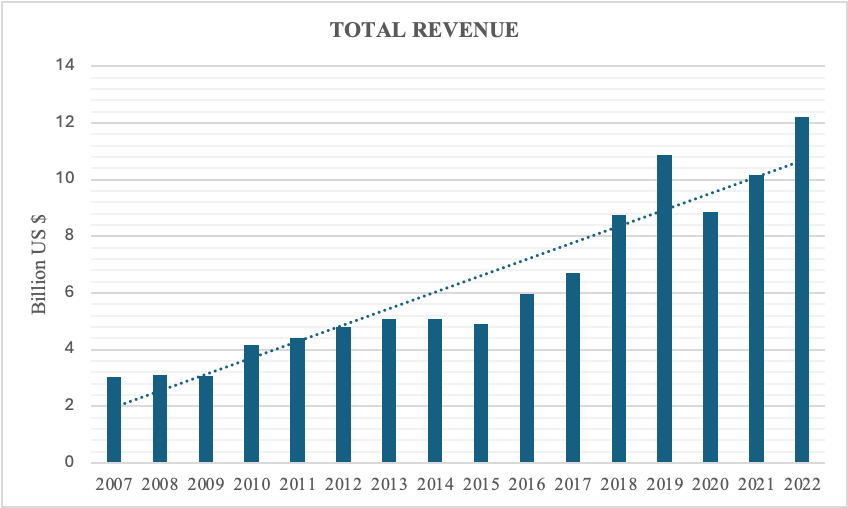
Türkiye’s defence industry relies on highly skilled labour and technology and requires high R&D expenditure. The market is dominated by a few large companies and several SMEs, with the state serving as the primary customer. Türkiye both domestically manufactures and imports products. Revenue generated by Türkiye’s defence industry shows an upward trend:
Source: SASAD Industry Reports
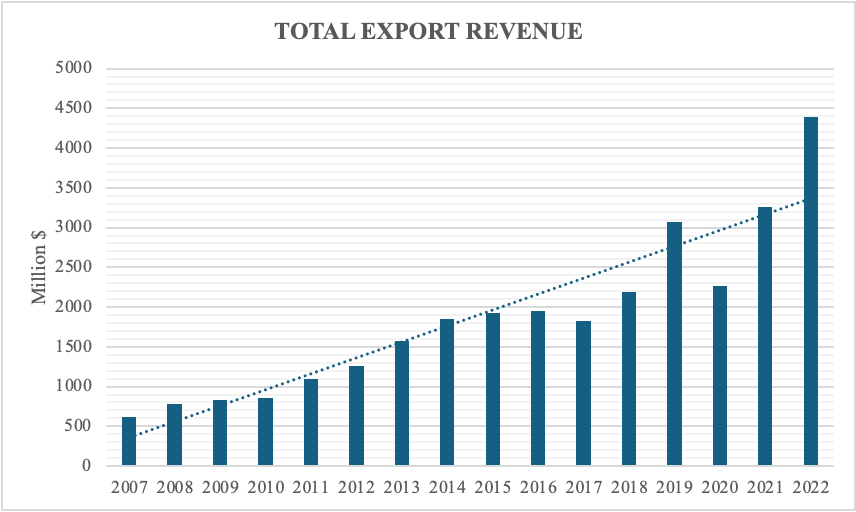
In parallel with the increase in total revenue, export revenue also shows an upwards trend with the Europe and the US as the top destinations:
Source: SASAD Industry Reports
Although the outlook in terms of revenue is favourable, the products are expensive due to high R&D costs, low volume production, and long development and procurement cycles. Therefore, the import of such products puts a strain on the budget, and negatively affects the balance of payments.
Economic reasons including the cost of importing defence products drive Türkiye’s commitment. Because, in the long term, the domestic defence industry benefits the economy by contributing positively to growth, creating new employment opportunities, reducing dependence on expensive imports, and generating revenue through exports. Moreover, exporting domestic defence products narrows the trade deficit as defence products are highly profitable. A strong domestic defence industry also mitigates risks associated with over-reliance on specific industries, such as textiles and agriculture in Türkiye, and increases the resilience of the economy. Another economic benefit of the domestic industry is the spillover of technology and innovation acquired within the industry to other sectors of the economy. Finally, an advanced domestic defence industry attracts foreign investment, providing foreign currency inflows to the country.
Türkiye’s defence industry is temporarily affected by domestic and global developments, such as the global economic slowdown and the Covid-19 pandemic. However, Türkiye’s defence industry addresses these unfavourable situations by taking measures such as increasing exports in the face of shrinking domestic demand.
Inflation and currency depreciation also have a significant impact on Türkiye’s domestic defence industry. The depreciation of the value of Turkish lira has both negative and positive impacts. Although the fall in the value of the Turkish lira means increasing costs for imported products, this is advantageous for exports as it increases the volume of exports. High inflation rates, on the other hand, can pose significant challenges to Türkiye’s domestic defence industry by increasing costs, constraining budgets, disrupting supply chains, and impeding investment and innovation. Addressing inflationary pressures and maintaining macroeconomic stability, as Türkiye is currently doing, is essential to support the long-term growth and sustainability of the defence sector.
Çağdaş Yüksel: Türkiye’s Sovereignty is inherently linked to its Maritime Security
Türkiye’s strategic location, military and economic power, and NATO membership position the country as a significant player in regional and global security dynamics. Additionally, its ‘Blue Homeland’ doctrine, which encompasses declared maritime jurisdiction areas, necessitates the Turkish navy to always remain strong and dynamic. In this context, the Turkish defence industry has also taken significant steps in developing advanced naval weapon systems and capabilities in recent years. These advancements demonstrate Türkiye’s determination in maritime innovation and security. These systems offer advanced capabilities for maritime operations, border defence, and alliance cooperation.
The MILGEM (National Ship), GENESIS (Ship Integrated Combat Management System), ADVENT (Network Enabled Data Integration) and MILDEM (National Submarine) projects have significantly increased the operational capabilities of the Turkish Navy. The developed navy elements are remarkable with their submarine defence, surface and air defence warfare capabilities, execution of advanced patrol activities, reconnaissance, surveillance, target detection, diagnosis, identification, and early warning features.
The GENESIS has provided the Turkish Navy with the capability to integrate weapons, sensors, electronic warfare systems, and various platforms from different countries and companies into its own structure. With the ADVENT, the navy has reached the point of producing its own next-generation command and control software that enables network-centric and supported operations on multiple ships. In this context, the integration process of the domestically produced armed unmanned marine vehicle ULAQ with the ADVENT software continues. Additionally, in terms of software, ASELSAN has designed and produced submarine sonars, satellite communication systems, integrated communication systems, navigation radars, and electronic support systems.
The development of indigenous weapons such as the AKYA Torpedo, Atmaca Anti-Ship Missile, Göktuğ Naval Gun System for naval platforms has reduced the Turkish navy’s external dependency in missile defence, surface-to-surface attacks, and air defence.
Türkiye’s most significant advancement in recent years is undoubtedly the TCG Anadolu Ship, which is the world’s first UAV (Unmanned Aerial Vehicle) ship. As the largest ship ever built for the Turkish Naval Forces, it is designed to accommodate different types of aircraft and helicopters, such as UAVs and Kızıl Elma, which can take off and land from its deck.
In conclusion, Türkiye is well-known for its advancements in defence technology and is further solidifying its position as an effective player in naval defence with its strides in domestic production. These productions not only strengthen the Turkish navy but also contribute to the country’s allies by being sold to other countries, benefiting the country’s economy. Pakistan and Ukraine each ordered four ships from the MILGEM. Additionally, among missile and rocket customers, countries such as Bangladesh, Algeria, and Indonesia are included. It is likely that Türkiye will make more sales to other countries due to the competitive prices of its ships and the support in terms of both firepower and modernization.
Türkiye’s security and prosperity are inherently linked to the seas that surround it. Having a strong navy in the region is crucial for protecting the Blue Homeland, ensuring Turkish sovereignty over its maritime borders in the Black Sea, Aegean Sea, and Mediterranean while contributing to NATO’s security umbrella in the region. As Türkiye continues to invest in defence technology, its position as a key player in maritime security will continue to expand, shaping the future of naval warfare regionally and beyond, and strengthening its deterrence capabilities.
Ömer Carullah Sevim: Türkiye’s Strategic Defence: Navigating Autonomy and Influence
The United States holds a commanding 40% share of the global arms sales market, a dominance that extends beyond economics and technology to include military and political influence over countries that have yet to develop robust national defence industries or diversify their arms purchases. The notion that economic interdependence can enhance international relations and foster peace holds merit, yet the balance and reciprocity within these exchanges, particularly in arms trading, are crucial.
Türkiye’s strategic location at the crossroads of Europe, Asia, and Africa, alongside its extensive coastlines along the Mediterranean and Black Sea and proximity to conflict zones, necessitates a nuanced foreign policy. With historical and cultural connections across the Muslim world and Central Asia, Türkiye’s unique position underscores its need for an independent foreign policy approach.
While Türkiye is a vital ally for the U.S., particularly as NATO’s only Muslim-majority member, its strategic interests and alliances extend beyond the Western military-political sphere, occasionally straining the U.S.-Türkiye relations. Recent tensions culminated in Türkiye’s removal from the F-35 program—a partnership dating back to 1999 with a $1.2 billion investment by Türkiye.
The U.S. Congress’s approval of new F-16 fighter jet sales and modernization kits to Türkiye has temporarily eased these strains. The approval of this deal was significantly influenced by a more accommodating stance from the White House following Türkiye’s endorsement of Finland and Sweden joining NATO. Additionally, the indictment of Bob Menendez, the Foreign Relations Committee chairman known for his connections to the pro-Greek and pro-Armenian lobbies, facilitated Türkiye’s position. The concurrent submission to Congress of the F-16 sales to Türkiye and F-35 sales to Greece suggests a strategic concession to the Greek lobby. This scenario underscores the critical impact of anti-Türkiye lobbying efforts in shaping Türkiye-US relations.
Anti-Türkiye lobbies used Ankara’s engagement strategy vis-à-vis Russia to undermine its position in Washington. Despite being a major drone supplier to the Ukrainian military, Türkiye also maintains a balancing act with Moscow. This stance, often criticised by anti-Türkiye lobbies, actually positions Ankara as a pivotal mediator in the conflict. Türkiye’s role in facilitating dialogue between Russia-Ukraine and Russia-US, as well as orchestrating the grain corridor agreement, exemplifies its critical influence in fostering peace. Hence, Türkiye’s balanced approach not only faces scrutiny from some quarters but also carves out avenues for diplomatic engagement.
The use of sanctions on arms procurement was counterproductive in the case of Türkiye. In 1974, the U.S. subjected Ankara to an arms embargo during the Cyprus operation. This was the beginning of Türkiye’s quest to establish a strong indigenous arms industry.
Established in 1975, ASELSAN symbolised the early efforts to bolster Türkiye’s national defence capabilities, a vision that has significantly evolved over the past decade. Türkiye has now achieved an 80% domestic production rate in its defence industry, doubling its global arms market share to 1.2% and ranking as the 12th largest arms exporter. This growth not only enhances Türkiye’s economic stature but also bolsters its political leverage and capability to pursue an independent foreign policy.
The procurement of military technology encompasses equipment acquisition, maintenance, and personnel training, potentially burdening countries reliant on foreign arms. Türkiye, however, has transformed past embargoes and sanctions into opportunities, significantly advancing its national defence industry and expanding its geopolitical manoeuvrability.
Ihsan Faruk Kılavuz: Turkey’s Aerospace Industry: A Leap into Global Defence Leadership
The remarkable ascent of Türkiye’s Defence Industry on the global stage is significantly attributed to the progress within Türkiye’s Aerospace Industry over the last twenty years. This advancement has catapulted Türkiye into the top tier of the world’s defence sector, positioning it as a pivotal player.
In this context, Türkiye has come to the limelight of the arms procurement sector, acquiring a significant stake in the defence industry with projects such as the ATAK Attack Helicopter, GOKBEY General Purpose Helicopter, Akinci-Aksungur-ANKA-Bayraktar, Karayel unmanned aerial vehicles, as well as the Hurkus Training Aircraft and the Gokturk Observation Satellite.
Türkiye’s rise as a prominent force in the global aerospace market is largely due to its successful reduction of foreign dependencies by bolstering domestic production, combined with effective marketing strategies.
Since ensuring manufacturing supply chains and service continuity is indispensable for becoming a global actor in the defence industry, it is essential to reduce external dependencies by increasing domestic manufacturing in the supply of parts, systems and software. Indeed, disputes between states and politically motivated embargoes can disrupt production chains and negatively impact continuity, hindering states’ defence industry advancements. Türkiye’s government, aware of this issue, has adopted policies prioritising indigenous and national production in the aerospace industry, recognizing that reducing external dependencies is crucial for Türkiye to become a global actor in the defence industry.
Bayraktar-TB2 is a case in point. On October 5, 2020, Canadian Foreign Minister Francois-Philippe Champagne announced the cessation of supplying camera systems to Türkiye for use in Turkish-made Bayraktar-TB2 drones utilised by the Azerbaijani Army during the Karabakh War, citing the use of Canadian-made systems in these drones. Likewise, Rotax, the manufacturer of engines and parts for Bayraktar-TB2 drones, imposed a similar embargo. Similarly, Andair, a British-based company providing various technical parts for Bayraktar-TB2, announced on January 11, 2021, the cancellation of all orders from Baykar, the producer of the drone, and ceased supplying parts.
However, rather than hampering the development of the Turkish Aerospace Industry, these developments had a positive impact, as domestically produced parts were integrated into drones instead of externally sourced components affected by the embargo. In this context, the integration of domestically produced TEI PD170 engines and ASELSAN CATS electro-optics prevented production disruptions and demonstrated to global stakeholders that the Turkish Aerospace Industry is not just an ordinary externally dependent market but a significant player in the sector.
Another essential element to becoming a global player in the defence industry is the ability to market products and services to foreign markets. Access to external markets increases visibility and contributes to meeting economic requirements, sustaining developmental activities, and allocating resources to new projects. In this context, marketing domestically produced goods to other countries plays a crucial role in the Türkiye’s Aerospace Industry’s aspiration to become a global player in the sector. For instance, the success of Bayraktar TB2 drones in conflicts such as Libya and Karabakh has significantly enhanced the visibility of the Türkiye’s Aerospace Industry’s achievements, leading to more international demand for these drones. Indeed, TB2 drones have been incorporated into the inventories of the armed forces of Azerbaijan, as well as those of Qatar, Ukraine, Turkmenistan, Morocco, Kyrgyzstan, and Poland. These exports have strengthened the global position of Türkiye’s Aerospace Industry.
In summary, leveraging domestic production capabilities to minimise reliance on foreign inputs, maintaining consistent manufacturing operations, and enhancing global visibility through strategic marketing of products and services are key to elevating Turkey’s Aerospace Industry to a global standing.


